




















A set of used winter tires often costs a fraction of a new set. But a tire that looks fine in a seller's garage can be too old, too worn or not a real winter tire at all.
This checklist takes about 10 minutes at the meet-up. Bring a Canadian quarter, a flashlight and, ideally, a tread depth gauge (a few dollars at any auto parts store).
1. Make sure it's a real winter tire
Look on the sidewall for the three-peak mountain snowflake symbol — a snowflake inside a mountain outline. It means the tire has passed a snow traction test.
An M+S (mud and snow) marking alone is not the same thing. It's based on tread geometry, and most all-season tires have it.
Why it matters by province:
- Quebec: from December 1 to March 15, vehicles registered in Quebec must have tires with the winter pictogram, or studded tires. The fine is $200 to $300.
- British Columbia: on most designated highways, winter tires or chains are required from October 1 to March 31 (April 30 on some routes). Tires need the M+S or mountain snowflake symbol and at least 3.5 mm of tread.
- Ontario: winter tires aren't mandatory, but insurers have been required since 2016 to offer a winter tire discount; the amount is up to each insurer.
2. Read the DOT date code
Find the code starting with "DOT" near the rim. The last four digits are the production week and year. For example, 1119 means the 11th week of 2019.
If the code ends in only three digits, the tire was made before 2000. Don't buy it.
Winter tires grip because their rubber stays soft in the cold, and that rubber hardens with age. A common industry guideline is to have tires inspected regularly after five years and to replace them by ten years, even if the tread looks fine. For used winter tires, we'd only pay full price for tires up to about five years old and ask for a discount on anything older.
Check the code on every tire. Sets are sometimes mixed.
3. Measure the tread
Tread depth decides how well the tire clears snow and slush. Measure in several grooves across each tire, including the inner and outer edges.
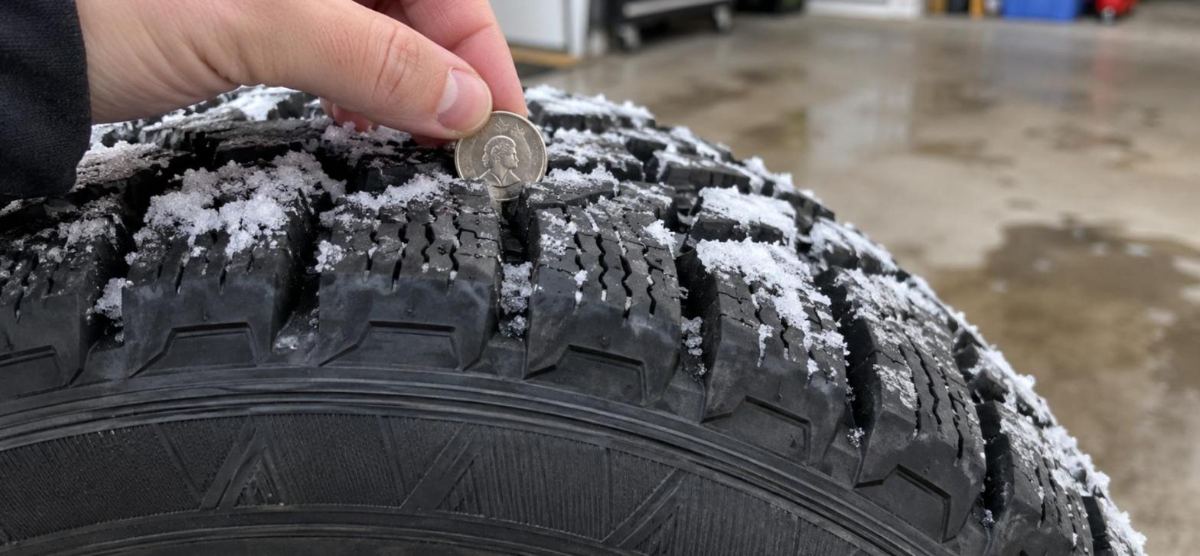
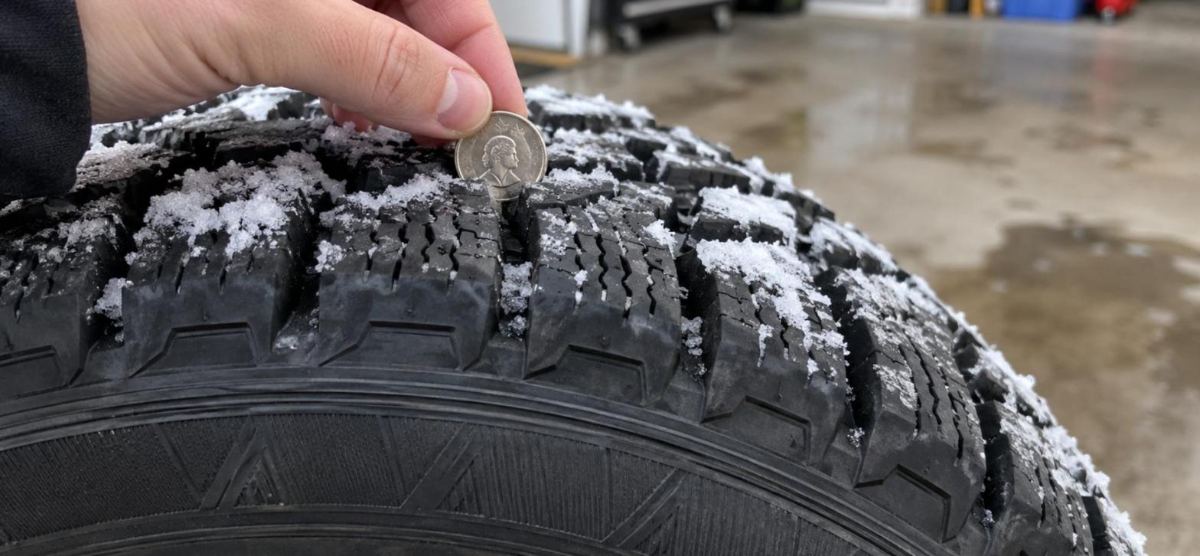
The quarter test: put a quarter into the groove with the caribou's nose pointing down. If you can see the caribou's nose, the tread is at or below about 4/32" (3.2 mm) and the tire won't grip well in deep snow.
| Tread depth | What it means |
|---|---|
| 1.6 mm (2/32") | Legal minimum in most provinces — tire is finished |
| 3.2 mm (4/32") | Practical minimum for winter use (Michelin Canada) |
| 3.5 mm | Minimum on BC designated winter highways |
| 4.8 mm (6/32") | Recommended winter depth (Government of Quebec) |
If the four tires differ by more than about 2/32", they'll handle unevenly. Factor that into the price.
4. Look for damage
Run your hand over the tread and around the sidewalls. Walk away if you find:
- cracks in the sidewall or between the tread blocks
- bulges or bubbles on the sidewall
- exposed cords or wire
- plugs or patches close to the sidewall
- uneven wear on one edge (a sign of bad alignment on the previous car)
Ask how the tires were stored. Indoors, out of the sun and away from heaters is best.
5. Match the size and the set
The size is on the sidewall, for example 215/60R16. It must match the size on the sticker inside your driver's door, along with the load index and speed rating next to it.
Buy four matching tires — same model and similar wear. Mixing winter tires with all-seasons, or putting winter tires only on the front, makes the car unstable on ice.
6. Tires on rims: check the fit
A set already mounted on rims saves you mounting fees every season. Before you pay, check:
- bolt pattern and centre bore match your car
- offset is within your car's range
- whether the rims have TPMS sensors (tire pressure sensors), if your car uses them
A tire shop can confirm the fit from the rim markings in a few minutes.
7. Questions to ask the seller
- How many winters have these tires been used?
- What car were they on, and why are you selling?
- How were they stored?
- Have any of them been repaired?
- Can I check the DOT codes and measure the tread before I pay?
A seller who refuses the last question is a seller to skip.
8. Meet safely
Tires are heavy, so meet-ups often happen in a driveway or garage. Go in daylight and bring a friend. In Ontario, many police services have marked exchange zones — see our list of police safe exchange zones in Ontario.
When to put them on
The Tire and Rubber Association of Canada recommends switching to winter tires once temperatures stay below 7 °C. In most of Ontario, that's November.
Find used tires near you
Browse used tires and wheels on Fiva, or post your old set for free if you've upgraded.
FAQ
Are 7-year-old winter tires safe?
They may still be usable if the tread is deep and the rubber has no cracks, but their grip on ice is lower than a newer tire's. Pay accordingly and have a tire shop inspect them.
Is M+S enough for winter?
In Quebec, no — you need the winter pictogram or studs. Elsewhere it's legal, but an M+S all-season tire grips far less in snow than a true winter tire.
Do all-weather tires count as winter tires?
All-weather tires with the three-peak mountain snowflake symbol meet the snow traction standard. Some Ontario insurers don't give the winter tire discount for tires left on year-round, so ask yours.
Can I buy just two winter tires?
It's not recommended. Four matching winter tires keep the car predictable when braking and turning on ice.